The Texas Examinations of Educator Standards (TExES) Pedagogy and Professional Responsibilities (PPR) EC-12 exam tests the applicant's knowledge and skills to be an entry-level teacher in Texas public schools. Anyone wishing to teach public school students in Texas ranging from early childhood (EC) up to the twelfth grade must take and pass this examination. This test is very important as it assesses test takers abilities to be an educator. The exam is a computer-administered test (CAT) and can be taken year-round by appointment at authorized TExES testing centers, including those outside of Texas. Applicants will have 4 hours and 45 minutes to complete the exam. The registration cost is $116 and is payable by VISA or MasterCard or using a debit or check card that have the VISA or MasterCard logo. No cash or personal checks are accepted, and payments are made on-line. Applicants will 170 days after paying to schedule an exam date, and failure to do so, will cancel registration and no refund of payment will be issued.
In short, the TeXES PPR Exam tests the candidate's knowledge of educational theory and the best practices utilized to teach early childhood students and grade 1-12 students. More specifically, the candidate will be tested on their knowledge to create lessons and assessments of student learning and of the best practices in creating a positive classroom environment. The test itself is subdivided into four sections, called domains, covering instruction and student learning, classroom environment, assessments and roles and responsibilities as a teacher.
Domain 1: Designing Instruction & Assessment to Promote Student Learning
Domain 1 contains 4 competency sub-sections and constitutes 34% of the exam. You can expect about 34 questions devoted to this section.
Child Development: This section covers development from early childhood to adolescence and tests the candidate's knowledge of techniques used to effectively instruct students. Understanding of how techniques are adapted as the student progresses through their schooling is key.
Teaching Diverse Students: The part of the exam will test the candidate's ability to adapt teaching methods and strategies to fit a diverse student body. This section also covers the 13 major categories of disabilities and techniques used to tailor teaching strategies for students with diverse needs.
Planning Instruction and Assessment: The candidate must know the procedures for effective instruction, and effective assessments of students. This section will test knowledge of the Texas Essential Knowledge and Skills (TEKS) and the candidate's understanding of Learning Goals vs. Learning Objectives.
Learning Process and Factors: The candidate's knowledge of learning theory is tested in this section. Command of learning theories such as Behaviorism, Cognitivism and Constructivism are important as are understanding of factors that impact the student's ability to learn.
Domain 2: Creating a Positive, Productive Classroom Environment
Domain 2 contains 2 competency sub-sections and constitutes 13% of the exam. You can expect about 13 questions devoted to this section.
The Positive Classroom: This section will test whether the prospective teacher understands how to create a classroom environment conducive to learning. The candidate must know how physical space affects the learning environment and understand the best practices for creating safe and inclusive environments. Candidates will be tested on their knowledge of promoting a positive classroom and establishing high expectations for students.
Classroom Management: This section tests the candidate's understanding of techniques used to manage student behavior. There is an emphasis on classroom routines and operation as well as behavior theories such as non-interventionism, interventionism, and interactionism.
Domain 3 contains 4 competency sub-sections and accounts for 33% of the exam. You can expect about 33 questions devoted to this section.
Effective Communication: This section of the exam will test the teacher's ability to effectively communicate through a variety of formats and contexts. Two key practices that will be assessed in the exam are wait time and skilled questioning.
Teaching Skills to Students: Best practices and techniques related to teaching students the skills they use in learning are tested in this section. Critical to this section is an understanding of the motivational strategies employed to help students meet their goals. This section also covers the unique skills development strategies used by students whom English is a second language.
Using Technology: This section tests knowledge of the appropriate use of hardware and software applications in the classroom. The candidate's proficiency in acquiring and manipulating electronic information and media is assessed. This part of the exam will also test the teacher's understanding of digital etiquette, safety, and guidelines established for privacy protection and compliance with copyright laws.
Assessment: The candidate's knowledge on how to measure student learning and success is covered by this section. Key concepts include providing students with clear and constructive feedback and teaching students to become skilled at self-assessment of their performance.
Domain 4: Fulfilling Roles & Responsibilities
Domain 4 contains 3 competency sub-sections and accounts for 20% of the exam. You can expect about 20 questions devoted to this section.
Family Involvement: This section tests the teacher's skills in communicating with the student's families and the community. Key concepts include knowledge of how to conduct effective conferences, communicate effectively with parents, as well as virtual communication with parents and others using email.
Effective Collaboration and Improving as a Teacher: Here a teacher's knowledge of interacting professionally with other educators is tested. This includes self-assessment of performance as a teacher and knowledge of the responsibilities of school district-level leaders, like the School Board and Superintendent.
Legal Basics: This section tests the candidate's knowledge of applicable laws and regulations affecting conduct as a teacher. An understanding of items like student and parental rights, copyright regulations, data security, privacy, and other policies like keeping student records are all critical to scoring well in this section.
Get a personalized test prep course for the TExES PPR EC-12.
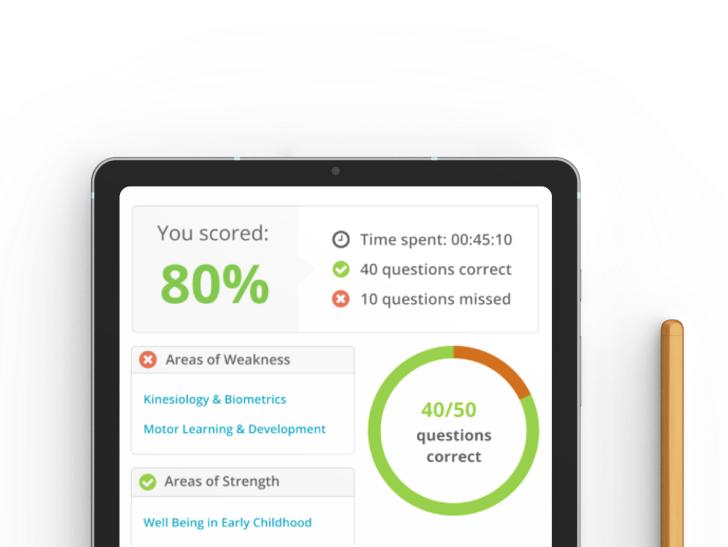
Take an assessment and focus on the areas that need the most practice.
The PPR exam consists of 100 questions, with 10 of them being evaluated for suitability as future exam questions. These 10 suitability questions are randomly distributed throughout the exam and do not impact the grade, which is based on the remaining 90 questions. TExES exam results will be posted to the candidate's account, and if they do not pass on the first try, they can retake the exam 45 days after the initial exam date.
TExES PPR Passing Score
The exam consists of 90 graded test questions, which are scored on a 100-300 point scale. There is no penalty for wrong answers, test takers are simply given points for the questions answered correctly. Candidates will need to score 260 points to pass the test, and the TExES PPR exam had a 96% passing rate in 2019.
TExES PPR Score Availability
After you complete the exam, your scores are made available to you within 7 days following your completion date, and sometimes sooner than that. Your score will be made available to you on the candidate account you created during the TExES exam registration, and can be accessed at 10AM central time, the day your results are posted.
TExES PPR Retake Policy
If you do not pass on your first try, do not be discouraged. You have the option of re-taking the TExES PPR Exam up to a total of 5 times. You will have to wait at least 45 days after your previous TExES exam dates to make another attempt, and you will have to re-register and pay the fee.
Watch concise and engaging video lessons that help with TExES PPR EC-12 prep.
Master concepts quickly with clips from expert instructors
You get both video lessons and test transcripts
Save time by quickly reviewing video transcripts for essential lesson information
Like any exam, passing the TExES PPR Exam requires preparation, as well as a variety of study techniques. The candidate will have access to a study guide, a practice exam, and some helpful suggestions on approaches for exam day. But making sure candidates start their exam preparations early is critical for success.
TExES PPR Study Guide
There are numerous study guides and materials that test takers can use to prepare for the TExES PPR. The first step in your TExES test prep will be to create a study plan. The next step would be to familiarize yourself with the content areas covered on the exam. You can then you begin to put your study plan into motion. You will need to gather information sources, like online study guides and textbooks from your library or previous teachers or professors. If you are able, joining a study group may go a long way to helping you prepare.
TExES PPR Practice Test
Taking practice tests is a very important part of doing well on the TExES PPR exam. Test takers can find find a wide variety of PPR practice tests available from free and paid online resources. Availing yourself to these resources will help prepare you for the testing environment, give you a feel for pacing yourself within the exam time limit, and help you assess how well you know the material.
TExES PPR Exam Tips
You will spend a lot of time studying and preparing for the exam, so here are some helpful tips for exam day:
Get a good night's sleep so that you are well rested for exam day.
Arrive at least 30 minutes early to the testing center and make sure you have 2 forms of acceptable ID.
Eat before taking the exam, you will need the energy!
Skip answers that you find difficult and return to these at the end, do not dwell on them and waste time that can be spent answering other questions.
Read the question and all the answers carefully before selecting the correct answer. You will encounter statements such as 'which of the following does' or 'which of the following does not'. Rushing through the question may lead you to select the incorrect answer.
There is no pattern of answers, do not allow that to influence your answer selection.
Pace yourself and be mindful of the time.
Do not worry about how you are doing on the exam or become frustrated with questions you find difficult. Keep your focus on answering the questions, not worrying about your score.
If you are not sure of the right answer, try to eliminate as many answer choices as possible, and if all else fails, guess. You are not penalized for incorrect answers and unanswered questions will surely receive no points.
Be calm and relax, you got this!
Find self-paced TExES PPR EC-12 prep courses.
Find a study plan that can get you ready for your certification exam, whether you have six months or six days.
Amy Lopez, M.A. is a high school teacher with over 8 years of experience teaching Family Consumer Science Education. She has passed the TExES PPR exam and the Praxis Family and Consumer Science Exam. Amy completed a B.S. in Family Consumer Sciences from Tarleton State University, an M.A. in Teaching from Grand Canyon University, and an Education Specialist degree from Northcentral University.
Frequently Asked Questions
How do I pass the TExES PPR exam?
Passing the TExES PPR exam requires preparation and planning. Reviewing an exam study guide, and familiarizing yourself with the exam content is important as is developing a study plan. Some students find that joining a study group helps them to prepare.
How many questions can you miss on the PPR to pass?
The exam score is based on 90 questions, where a minimum score of 260 out of 300 points are required to pass
Is the TExES PPR test hard?
Different candidates will have different opinions about the level of difficulty of the exam. The TExES PPR exam has a 96% passing rate, and focused and systematic preparation for the exam should help you to do well on the exam.